
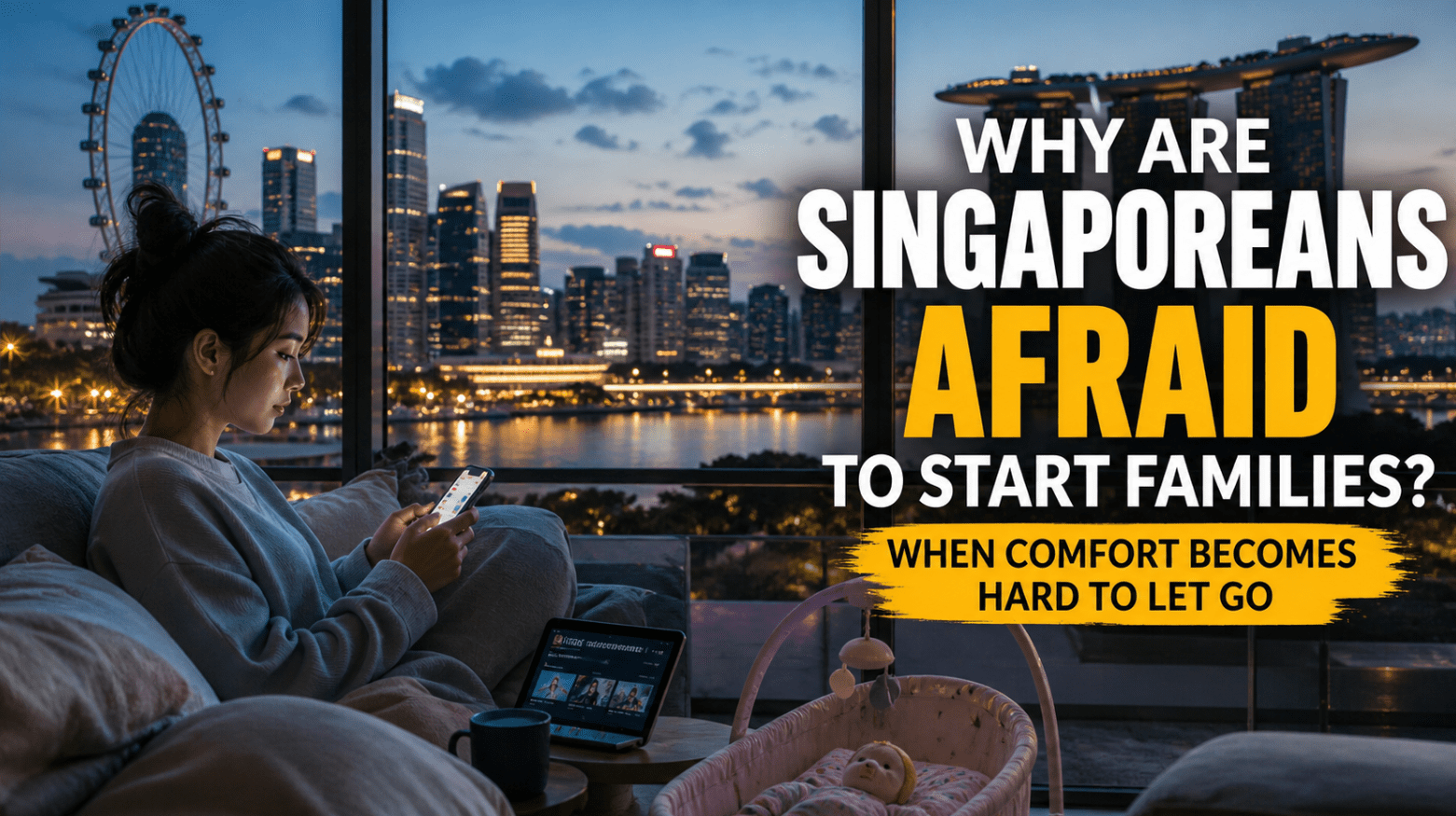
Singapore has done almost everything right. So why is this still happening
Singapore has spent years trying to make parenthood easier. More cash support, better leave, stronger housing access. Now, with the Marriage and Parenthood Reset Workgroup, the question is being asked again: why are fewer people choosing to start families?
But maybe the answer is not hiding in policy gaps. Maybe it is something far more uncomfortable.
Singapore has succeeded in building a life that is stable, predictable, and comfortable. And for many, that comfort has become something worth protecting. Because when life already feels complete, the idea of a child is no longer just a blessing. It feels like a disruption.
A generation that did not have to struggle the same way
Let’s acknowledge something honestly.
Many young Singaporeans today grew up in a system that worked.
Their parents did the hard part. Long hours. Financial pressure. Sacrifices that were not always visible.
What followed was a generation raised with:
- stable education pathways
- reliable income expectations
- strong public infrastructure
- a sense of security in daily life
This is not a criticism. This is success.
But success changes behaviour.
When survival is no longer the priority, lifestyle becomes the focus.
When comfort becomes something you protect
Comfort is not just about money.
It is about control.
Control over:
- your time
- your routines
- your energy
- your personal space
A normal day today might include scrolling, streaming, gaming, socialising, or simply doing nothing without pressure.
Over time, this becomes your baseline.
Your version of a good life.
So when the idea of a child enters the picture, the question is no longer just financial.
It becomes deeply personal.
What will I have to give up
The cost we do not say out loud
We often talk about the cost of raising a child.
But there is another cost that is harder to quantify.
The cost of losing control.
Children do not fit into neat schedules.
They disrupt:
- sleep
- routines
- freedom
- spontaneity
And for a generation that has built life around personal control and flexibility, this feels overwhelming.
So the hesitation is not always about affordability.
Sometimes it is about readiness to let go.
The quiet truth about me time
Let’s say it clearly.
Many people today value their me time.
Not in a selfish way.
But as a form of recovery.
Work is demanding. Life is fast. Expectations are high.
So personal time becomes sacred.
It is the space where you:
- breathe
- recharge
- feel like yourself again
Now imagine introducing something that requires constant attention.
Not occasionally. Daily.
That is where the tension begins.
Not between money and responsibility.
But between identity and responsibility.
Why this hits women differently
This conversation cannot ignore reality.
The weight is not equal.
For many women, having a child is not just an addition to life.
It reshapes life.
There are still expectations:
- to be emotionally present
- to manage the household rhythm
- to balance career continuity
Even in supportive environments, the mental load is real.
So when we talk about comfort and control, for women it is deeper.
It is not just about losing free time.
It is about shifting identity, responsibility, and expectations all at once.
This is not about blaming a generation
Let’s be fair.
This is not about saying people are lazy or entitled.
It is about recognising a shift.
Singapore has created:
- stability
- safety
- predictability
And naturally, people adapt to that environment.
They optimise for comfort, efficiency, and personal well being.
So when a decision comes along that disrupts all three, hesitation is expected.
What policies cannot solve
Policies can support families.
They can ease financial burdens and improve systems.
But policies cannot:
- create emotional readiness
- change personal priorities
- remove the fear of losing control over one’s life
And this is where the gap lies.
The challenge is no longer just economic.
It is psychological.
Maybe this is the real question
Singapore is asking how to encourage more people to have children.
But perhaps the deeper question is this:
Have we become too comfortable to change
Because starting a family has never been just about money.
It has always been about willingness.
Willingness to adapt.
Willingness to give.
Willingness to step into something uncertain.
Maybe the issue is not whether Singaporeans want children.
Maybe it is whether they are ready to let go of the life they have grown comfortable with.
Related Reads
New workgroup to drive marriage and parenthood reset in S’pore amid record low fertility
Halimah Yacob and the Everyday Empowerment of Women in Singapore