Long before social media clips made her a familiar face, she had already built a life of study, service and family. Her story is not about standing beside a famous name. It is about what she built in her own name.
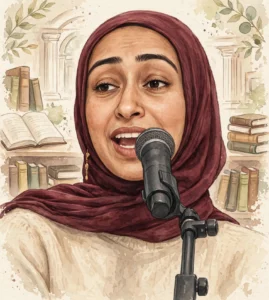
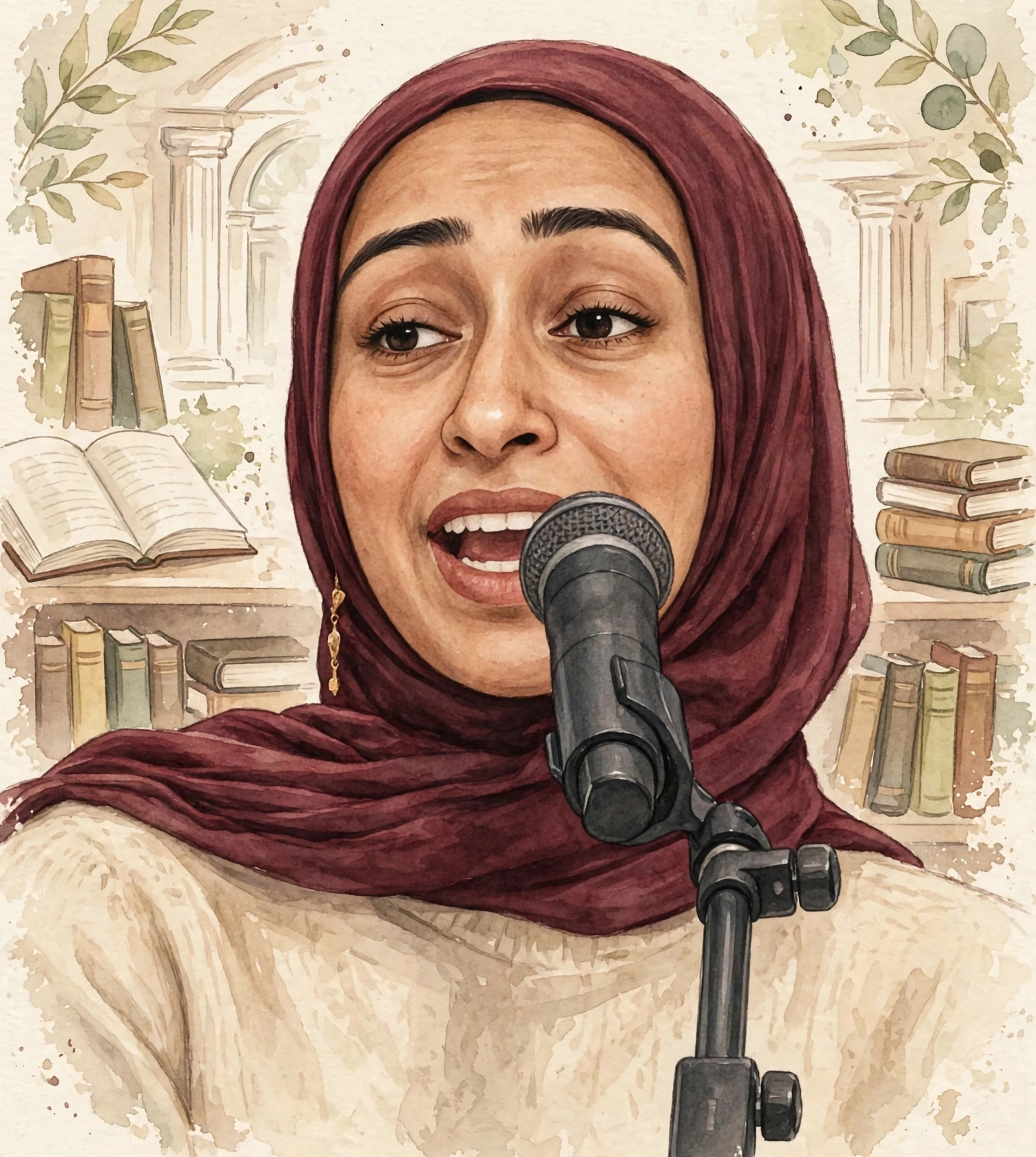
AI editorial illustration, transformed for Trailblazing Muslimahs: warm cream background, maroon hijab, books and university columns. Not a photograph, and not a direct copy of any news frame.
You may have met Dr Sarah Jukaku the way many people recently have: in a short video, smiling beside her husband, or speaking warmly about who he is at home. The clips travel fast. They also tell only a small part of the story.
Behind those few seconds is a psychiatrist from Michigan, a mother of two daughters, and a daughter of a family that carried learning and medicine across continents. She did not seek a public profile. For twenty years of marriage, she kept one deliberately quiet, while she built a medical career that stands on its own merits.
That choice is what makes her a trailblazing Muslimah in the truest sense. Not loudness. Not self promotion. Steadiness, study, service and family, held together over time.
At a glance
- Born and raised in Michigan, in an Indian immigrant family with roots in Bhatkal, Karnataka.
- Studied sociology and Near Eastern studies at the University of Michigan, then earned a master’s degree at the University of Oxford.
- Earned her medical degree from Columbia University’s Vagelos College of Physicians and Surgeons in 2015.
- Served as a joint chief of psychiatry at University of Michigan Health, then opened her own practice, Mind Work Psychiatry, in Ann Arbor.
- Married Abdul El-Sayed in May 2006. Mother of two daughters, Emmalee and Serene.
When a private life suddenly became public
In August 2026, her husband, Dr Abdul El-Sayed, won Michigan’s Democratic primary for the United States Senate, as reported by American Kahani. Almost overnight, search interest in his wife surged. People wanted to know who the woman beside him was.
The answer was both simple and easy to miss. She was already someone: a doctor, a colleague, a mother, a woman known in her own circles for care and calm, not for campaigning. As American Kahani put it, she had spent twenty years maintaining a deliberately quiet public profile while building an accomplished medical career separate from his political ambitions.
That is an important distinction for readers. Fame arrived late. The work came first.
Featured Partners
Abdul Rahman Law Corporation
RI Featured Partner
Trusted legal guidance for life and family. Legal help for Muslim families: Syariah matters, Wasiat, Hibah, estate planning, probate, conveyancing and civil disputes.
Call: +65 6277 4100
WhatsApp: +65 9066 4196
Email: ask@arlc.com.sg
Address: 727 North Bridge Road, Singapore 198695
Tailwinds Travels
Featured Partner
Travel with peace of mind. Thoughtfully planned journeys with comfort, care and halal friendly experiences.
Shaik Sabri: Wedding & Event Catering
Featured Partner
From weddings to grand events. Dam briyani, wedding favourites and trusted catering for celebrations across Singapore.
Partner Opportunity
Your expertise. Their next step.
Showcase your services to women and families through a thoughtful editorial feature on Trailblazing Muslimahs.
Roots in Bhatkal, a town built on learning
To understand Sarah Jukaku, it helps to look further back than Michigan. Her family roots trace to Bhatkal, a coastal town in Karnataka, about 140 kilometres from Mangaluru, as traced by The American Bazaar, which travelled to the town to follow the family story across three generations.
Bhatkal is known for its centuries old maritime trading traditions and for the Nawayath community, a Muslim community shaped by trade, migration and learning along India’s western coast. Her grandfather, J. H. Shamsuddin Jukaku, was a lawyer, educator and political figure who served as deputy minister for finance in Mysore State. Residents still remember his work for education and community institutions, including his close association with Anjuman Hami-e-Muslimeen, one of Bhatkal’s major educational bodies.
Her father, Dr Jukaku S. Tayeb, carried that emphasis on education into medicine. He trained at Bangalore Medical College, later worked abroad, and eventually settled in Michigan as a nephrologist. One generation helped build schools and institutions in coastal Karnataka. The next built a medical life in the United States. Sarah would become the third generation to choose medicine, this time in psychiatry.
A campus meeting, and a promise to grow together
Sarah and Abdul met as students at the University of Michigan in Ann Arbor, where both were part of campus life, including the Muslim Students’ Association. She was still a freshman when they became engaged. She was 19 and he was 21 when they married in May 2006.
What she remembered from those early days is telling. He first struck her as a complete jock, always in lacrosse gear. Then she discovered he was also sharply intelligent. He, in turn, has described her as the smartest person he has ever met, and also the most grounded and humble.
“We are still growing, now we can grow together.”
As recalled by Sarah Jukaku, via The American Bazaar
That sentence captures the heart of their story better than any viral caption. Marriage, for them, was not presented as an ending to personal growth. It was a shared beginning. Both were still students. Both still had long roads of study ahead. They chose to walk those roads together.
In his memoir, Healing Politics, he wrote that she danced with her emotions while he wrestled with his own, and that in time she taught him to dance, awkwardly, with his too. It is a gentle image, and it says something important about partnership: sometimes strength looks like helping another person understand their own feelings.
A medical career built on its own merits
After Michigan, Sarah pursued a master’s degree at the University of Oxford. She then studied medicine at Columbia University’s Vagelos College of Physicians and Surgeons, graduating in 2015. Her training took her through internship and residency, and back to Michigan, where she worked at University of Michigan Health.
There, she served as a joint chief of psychiatry at University Health Services, a leadership role that speaks to trust from colleagues as well as skill with patients. She later opened her own private practice, Mind Work Psychiatry, in Ann Arbor, while keeping a connection to academic medicine.
Her practice focus, as described in published profiles, includes anxiety disorders, psychosis, and culturally informed care. That last phrase matters. Culture shapes how distress is felt, described and treated. A psychiatrist who understands South Asian family life, faith, migration and the pressure to keep going quietly can hear things that might otherwise stay unsaid. For many Muslim women reading this, that kind of listening is not a luxury. It is safety.
It is worth pausing here. Too often, a woman in the news is introduced only through her husband. Sarah Jukaku reverses that habit. Her degrees, her leadership role and her practice came from years of study and clinical work. They would matter even if no camera had ever pointed at her family.
Motherhood, illness, and a lesson in support
One of the few deeply personal stories she has shared publicly came during her residency years. After the birth of their first child, she experienced serious medical complications. In a campaign video, she described how her union helped secure the medical leave she needed during recovery, without losing her position.
For a doctor in training, that is not a small detail. Residency is demanding at the best of times. To be acutely ill after childbirth, and to need time to heal while holding on to a career you have worked years to build, is a test of both body and system. Her account, reported by American Kahani, strengthened her belief in workplace protections for medical professionals.
For mothers reading this in Singapore, the parallel is clear, even though the systems differ. Support after birth is not a favour. It is what allows a mother to heal, a family to settle, and a professional to return with strength intact. When support is missing, women are forced to choose between health and work. When it is present, they do not have to.
Today, the family lives in Ann Arbor with their two daughters, Emmalee and Serene. He has described himself as a proud girl dad. She is described by him, affectionately, as a mama bear, a mother who fiercely prioritises family. Those are his words, not a job title. But they fit the wider picture: a home shaped by both Indian and Egyptian traditions, by faith and shared values, and by two parents trying to protect ordinary family time even as public life grows louder.
A little more: Abdul as husband, not only as senator
This article is about Sarah, not a full biography of her husband. Still, one part of his story helps readers understand why she became visible in 2026. The Rethinking Islam companion story on this family focuses on a town hall in Caro, Michigan, on 17 October 2026, where Abdul El-Sayed was asked about loyalty, faith and the Muslim Brotherhood, and where he spoke about religious freedom and equal belonging.
On 3 November 2026, he was elected to the United States Senate, becoming the first Muslim elected to the Senate. At the time of this editorial note, on 4 November 2026, he had won but had not yet been sworn in. That is an important distinction for readers following the story in real time.
The husband picture is more intimate than the election picture. He has called her the smartest person he has ever met. In a Valentine’s Day video, he described her as the best of us and called her an incredible doctor, wife and mama bear. He also described himself as a proud girl dad, sometimes making pancakes with the children. The campaign is one chapter. The family is a longer one.
Compared with his 2018 campaign for governor of Michigan, the 2026 campaign put their family under far more national pressure. That pressure is why so many profiles now try to describe Sarah in a single line. The fuller story, and the slower one, is in her training, her practice and her family history, not in a headline.
Seen together, the two stories make sense: a man in public office, and a woman who chose a quieter public profile while building a career that did not depend on him. Both are true. Neither cancels the other.
Read the full Rethinking Islam story here for his side of that town hall, and for the wider context of religious freedom in American politics.
What Singapore readers can take from her story
Sarah Jukaku does not live in Singapore. Her story still speaks to Singaporean women, because the pressures are familiar: work that demands years of training, family expectations, faith, and the wish to be seen as a person in your own right.
- Quiet is not small. A quiet public profile can still hold a serious career.
- Care for the mind is care for the family. Psychiatry, at its best, helps people name distress and find a way forward.
- Roots matter. Knowing where your family came from can give strength when life in a new place feels uncertain.
- Partnership can be growth. Marriage does not have to end personal ambition. It can be a shared project.
- Privacy is a choice. Not every part of a life has to be public to be real.
For Muslim women balancing career, children, parents and community work, her story is a reminder that strength is often built quietly: in study, in clinics, in homes, and in the decision to keep going after illness or setback.
That is why she belongs in a series on influential women. Influence is not only measured in speeches or followers. It is also measured in patients helped, in daughters raised, and in a life lived with integrity.
A note on sources: This article is based on published reporting, including The American Bazaar, American Kahani, Times of India, WION and the Rethinking Islam companion story. It does not rely on social media captions or unverified claims about private family details. Where a detail comes from an interview with Sarah Jukaku herself, that is stated in the text.
More Reads
If this story stayed with you, explore other women whose quiet work changed their communities, and return to Trailblazing Muslimahs for stories on wellbeing, work and family life, written for women building life on their own terms in Singapore and beyond.
Sources
- The American Bazaar: Sarah Jukaku, Indian roots and family history in Bhatkal
- American Kahani: Dr Sarah Jukaku, medical career and quiet public profile
- Times of India: Sarah Jukaku, family roots in Bhatkal, Karnataka
- WION: Who is Sarah Jukaku and her Indian connection
- Rethinking Islam: He Was Asked to Prove His Loyalty Because He Is Muslim. Then America Elected Him Senator.